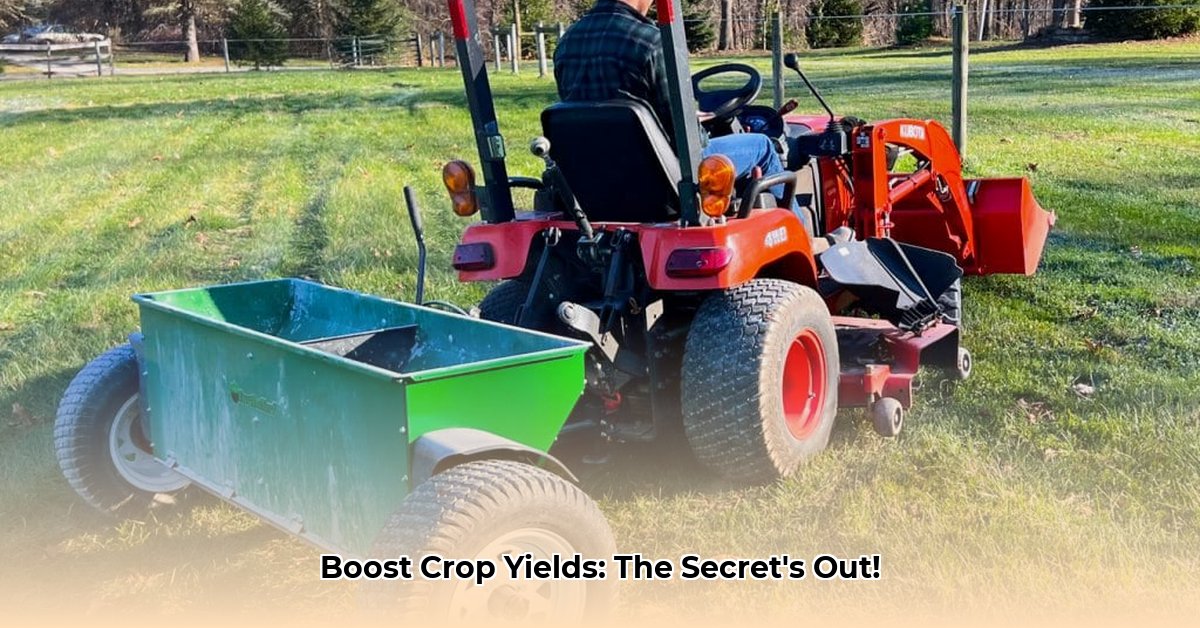
Lawn Tractor Drop Spreaders: Precision Fertilizer Application for Sustainable Agriculture
Let's address the persistent challenge of fertilizer waste in agriculture. Traditional broadcast spreading methods lead to significant nutrient loss and environmental damage. This guide explores how lawn tractor drop spreaders, such as the SnowEx Drop Pro 1400, offer a precise, efficient, and sustainable alternative. By targeting fertilizer application directly to plants, these tools maximize nutrient uptake, minimize runoff, and boost crop yields. For more on lawn tractor options, check out these helpful resources.
Understanding Drop Spreaders: A Targeted Approach to Fertilizer Application
Unlike broadcast spreaders that disperse fertilizer over a wide area, drop spreaders deliver nutrients precisely to the plant's root zone. This targeted approach, illustrated in [Diagram/Illustration 1: Comparison of Broadcast vs. Drop Spreading], reduces waste dramatically. Imagine the difference between watering your garden with a hose versus using a watering can – focused application ensures each plant receives the optimal amount of nutrients. This precise delivery is crucial for optimizing fertilizer use efficiency and minimizing environmental impact.
Choosing the Right Drop Spreader: Factors to Consider
Selecting the appropriate drop spreader involves careful consideration of several key factors.
- Hopper Capacity: The size of your operation dictates the required hopper capacity. Larger farms need spreaders with larger hoppers to minimize refill time.
- Material Compatibility: Ensure the spreader is compatible with the type of fertilizer you use (granular, liquid, etc.).
- Ease of Use and Calibration: User-friendly controls and straightforward calibration procedures significantly impact operational efficiency. Look for spreaders with clear instructions and readily adjustable settings.
- Cost: While upfront investment is a consideration, the long-term savings from reduced fertilizer use and increased yields should be factored in. A cost-benefit analysis will help determine the best balance between initial investment and long-term return.
[Table 1: Comparison of Drop Spreader Features and Costs] (This table would list various models, their features, and price points, allowing for comparison).
Calibrating and Operating Your Drop Spreader: A Step-by-Step Guide
Accurate calibration is paramount for optimal performance. The following steps ensure even fertilizer distribution:
- Measure your field: Accurately determine the area to be fertilized.
- Weigh your fertilizer: Precisely measure the fertilizer quantity to achieve the desired application rate.
- Adjust spreader settings: Consult your spreader's manual for guidance on adjusting spread width and fertilizer flow rate based on your chosen fertilizer and application rate.
- Test run: Before full application, conduct a trial run in a small area to check for even distribution. Adjust settings as needed, observing the pattern and density of fertilizer placement.
- Apply fertilizer: Once calibration is complete, apply fertilizer, maintaining consistent overlap between passes to ensure uniform coverage.
Remember to always consult your spreader's manual for specific instructions.
Maintenance and Troubleshooting: Ensuring Optimal Spreader Performance
Regular maintenance prevents costly repairs and ensures consistent performance.
- Routine Inspection: Regularly inspect for damage, wear, and tear.
- Cleaning: Clean the hopper and dispensing mechanism after each use to prevent clogging.
- Lubrication: Lubricate moving parts as per the manufacturer's recommendations.
Troubleshooting Clogs: If a clog occurs:
- Safety First: Turn off the spreader and disconnect the power source.
- Access the Hopper: Carefully access the hopper and remove the obstruction.
- Thorough Cleaning: Clean the chute and other affected areas.
- Reassemble and Test: Reassemble the spreader and perform a test run to ensure the issue is resolved.
Case Studies: Demonstrating the Effectiveness of Drop Spreaders
[Case Study 1]: A study by [Name and Affiliation] demonstrated a [Quantifiable Percentage]% reduction in fertilizer waste and a [Quantifiable Percentage]% increase in crop yield using a drop spreader compared to traditional broadcast methods. [Cite the Study]
[Case Study 2]: [Another Quantifiable Example of Successful Implementation]
Economic Considerations: The Return on Investment
While there's an initial investment in a drop spreader, the long-term cost savings are substantial. Reduced fertilizer use, increased yields, and minimized environmental impact contribute to a strong return on investment. [Provide a simplified cost-benefit analysis table, comparing drop spreader costs to the costs and potential savings from broadcast methods, for a typical farm size]
"The cost savings from reduced fertilizer alone often justify the purchase within a few seasons," says Dr. [Name and Title], [Affiliation].
Regulatory Compliance: Adhering to Local and National Regulations
Familiarize yourself with local and national regulations regarding fertilizer application. These rules may vary depending on location and the type of fertilizer used. Ensure compliance to avoid penalties and contribute to sustainable agricultural practices.
Conclusion: Sustainable Agriculture Through Precision Fertilizer Application
Lawn tractor drop spreaders provide a powerful tool for sustainable agriculture. By delivering fertilizer precisely to plant roots, these systems drastically reduce waste, improve yields, and minimize environmental impact. Through careful selection, proper calibration, and regular maintenance, farmers can maximize the benefits of drop spreaders, contributing to both improved profitability and environmental stewardship. Adopting this precision approach is a significant step towards a more sustainable and efficient agricultural future.